




Why is placing education at the center of national development one of the most urgent and sustainable choices Haiti can make?
In Haiti, national development is often discussed through the lens of security, roads, hospitals, electricity, and political stability. These priorities matter. However, beneath all of them lies a deeper foundation that has too often been neglected: education.
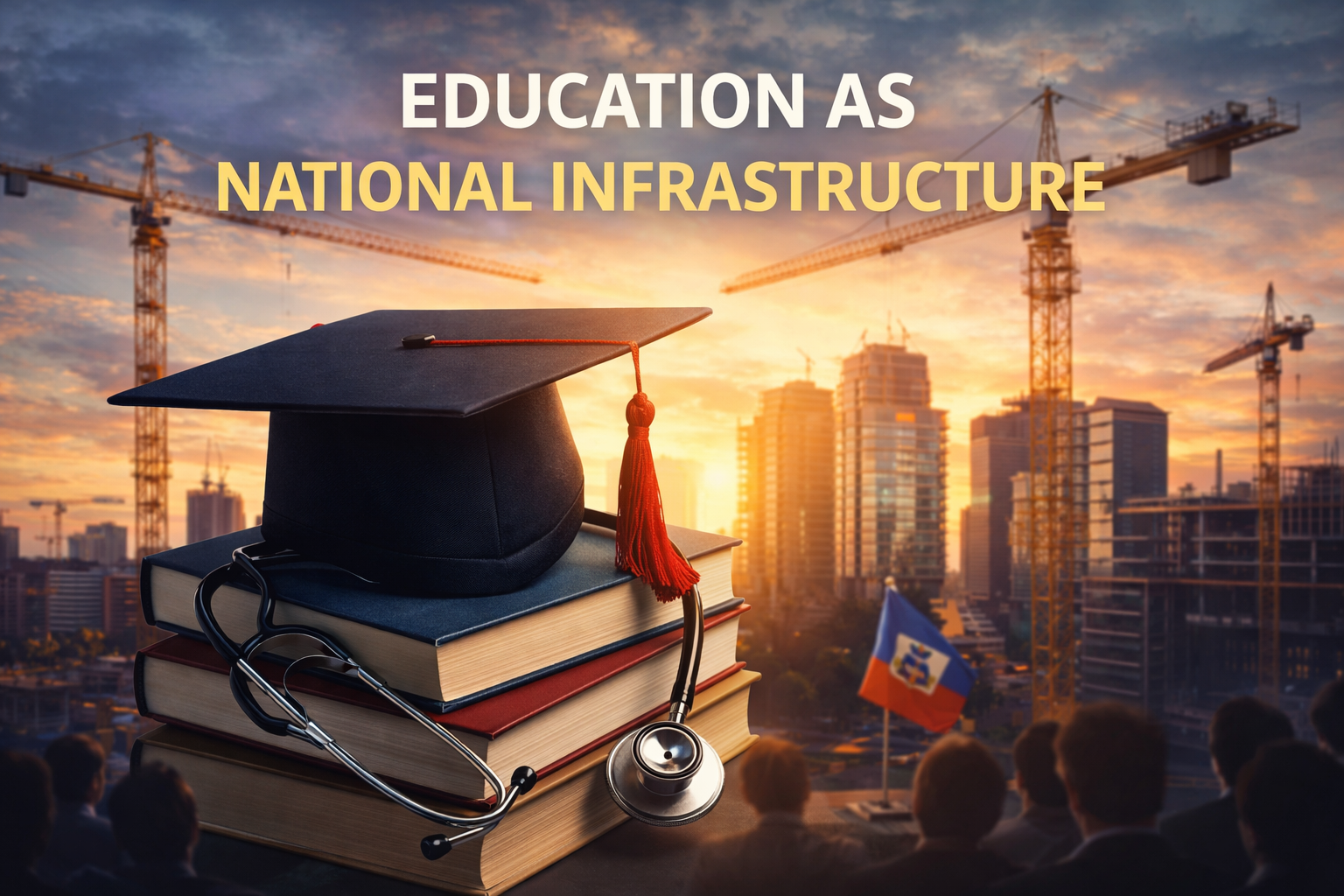
If Haiti is serious about rebuilding itself and creating a stronger future, education must no longer be treated as a secondary issue. It must be treated as national infrastructure. Just as roads connect communities and electricity powers economic activity, education builds the human capacity that allows a nation to rise, govern itself effectively, and develop with dignity.
For Haiti, this is not an abstract idea. It is a national necessity. A country cannot transform itself if too many of its young people are left without quality schools, practical skills, civic formation, and real opportunities to grow. Education is what prepares future teachers, doctors, entrepreneurs, engineers, public servants, and ethical leaders. It is what gives a nation the ability to solve its own problems rather than depend endlessly on outside solutions.
Haiti has immense human potential. Its youth are intelligent, creative, resilient, and capable of extraordinary things. But potential alone is not enough. Without a strong educational system, that potential remains underdeveloped, and the country continues to lose talent, energy, and hope.
When education is weak, every sector suffers. Institutions become fragile, inequality deepens, and development remains unstable. Treating education as infrastructure means seeing schools, universities, vocational centers, teacher training, and digital learning platforms as part of the nation's core architecture. It means investing in them with the same seriousness given to physical construction. It means understanding that the future of Haiti will not be built by concrete alone, but by knowledge, discipline, innovation, and civic responsibility.
For Haiti, education is more than a social good. It is a strategic tool for national recovery and long-term sovereignty. Foreign aid may come and go. Governments may change. Crises may continue to shake the country. But an educated population remains one of the few assets that can strengthen Haiti from within and sustain progress across generations.
In Closing
If Haiti wants a different future, it must build it through its people. And that begins by recognizing education not as an afterthought, but as one of the most important forms of national infrastructure the country can invest in.
Comments 0